Regulated Work
Actionable Discovery for Working with Regulated Data
High-stakes data work shows up across many contexts, but the demands are consistent.
Teams are expected to work through large volumes of unstructured data, under tight timelines, with decisions that must hold up to scrutiny later.
That work typically spans four core activities:
— Find what matters
Litigation, investigations, and contract review.
— Make defensible decisions
Investor and operational data room analysis.
— Identify sensitive data
Breach response and regulatory risk assessment.
— Take repeatable actions
Preservation, separation, and deletion when action is required.
These activities appear across litigation, investigations, contract review, breach response, regulatory risk assessment, and ongoing compliance. Sometimes they happen independently. Often they overlap. When they are disconnected, work slows and risk increases.
Keeping them connected is what allows teams to move quickly without sacrificing defensibility.
Discovery
Opposing counsel just surfaced a document you should have found.
The problem wasn't effort. Your search tools don't understand documents the way you do.
FIND WHAT MATTERS
Discovery is the work people do to find anything from the files they know they have, to complex regulatory filings with section references buried in the footnotes.
People create their own search terms by keyword or topic. They often remember what a file was about, but not the exact words or where it's stored. It could be an email. A file on a laptop. Something in SharePoint. So they search, open a file, and use CTRL+F to understand why it matched. Over. And over again.
Real World Results
After months of stalled progress reviewing 1TB of discovery data, a law firm deployed Thermal and narrowed the dataset to 160,000 potentially responsive files. Within that set, the team conducted targeted searches to identify and tag the documents that mattered for trial, organizing them by witness and charge in days.
What Thermal Solves
In legal discovery, investigations, and internal reviews, people are handed large volumes of documents and expected to quickly and defensibly identify what matters, organize it by case, matter, or witness, and prepare it for review. Time needs to be spent on analysis, not on file-by-file search and then renaming copies to keep relevant files organized.
Business teams face the same challenge when locating contracts or licensing agreements tied to everyday operations. You're not just searching, you're guessing where to even start looking. Email. A laptop. SharePoint. A network drive. If you find a license agreement, is it the most current version? How many other versions exist, and do they include the same terms?
Thermal fixes that.
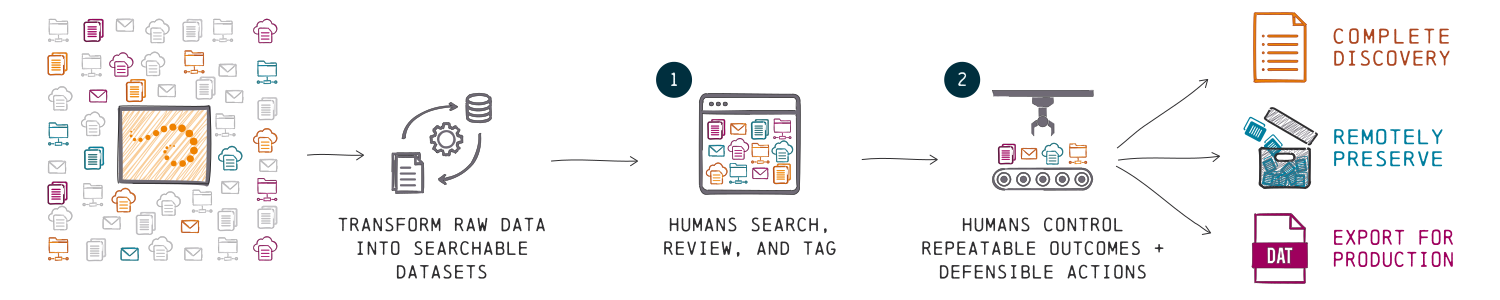
Thermal changes discovery by giving people confidence that they found everything that matters. CTRL+F is replaced with forensic-grade search queries and the precision of legal research tools like LexisNexis or Westlaw applied to their own files. Enter a keyword or topic once. Review highlighted matches across thousands of documents without opening files one by one. Search headers. Search footnotes. Tag what matters by case, custodian, or witness and move on.
Original files stay where they are. No copies. No proliferation. Finish your analysis in Thermal or send files downstream to eDiscovery platforms like Relativity and Nuix.
Core search, review, and preservation are grounded in proven digital forensics techniques, involve no AI, and are repeatable, documentable, and defensible.
How Discovery Work Changes with Thermal
- From searching → review
One defensible keyword and topic search, targeted to specific sections. Highlighted results with in-app preview. Click-to-review. Tags instead of copies. - From manual preservation → remote execution
Legal hold and remote collection designed during COVID and battle-tested clearing backlogs of thousands of laptops. Tens to hundreds of collections run concurrently across distributed custodians, without anyone needing to get on a plane.
For discovery, Thermal is intentionally designed so AI use is optional, reflecting the needs of legal teams that must sometimes work without it.
When teams choose to use AI, it operates only on human-curated files and supports answering questions, completing questionnaires, identifying sensitive data, and surfacing discrepancies, with every result sourced and highlighted for human review.
Use Cases
- General "I know I have this file" discovery
- Contract and license agreement discovery
- Early case assessment (ECA)
- Litigation and investigation discovery
- Remote legal hold preservation
Diligence
Ever try finding a specific answer inside a virtual data room?
And once you find the document, how do you know it tells the full story?
MAKE DEFENSIBLE DECISIONS
Diligence is the work teams do to turn large volumes of virtual data room files into clear, usable answers.
For asset managers, this often means evaluating new managers, strategies, or portfolio companies by reviewing thousands of documents under tight timelines.
Teams race to complete questionnaires, identify risks, surface conflicting terms or clauses, and spot gaps in governance, controls, or disclosures. The hard part is not asking questions, it's finding the right answers and showing where they came from.
Real World Results
Diligence teams using Thermal have indexed over 649,000 files and generated more than 100 million tokens of content for AI language models. By reviewing highlighted search results directly in Thermal's preview pane, tagging what matters, and having documents prepared automatically for AI analysis, teams avoid manual document opening and repeated in-document CTRL+F searches, reporting hours saved per day along with improved consistency and defensibility.
What Thermal Solves
In diligence, teams are expected to extract clear answers from thousands of documents and turn them into a defensible report. Risks must be identified, inconsistencies surfaced, and disclosures reconciled against validated external information, with every conclusion grounded in reviewed source material.
For asset managers, the challenge goes further. Conclusions drawn from data room materials must be reconciled with what's known from validated external sources, such as market data, performance history, and third-party disclosures. Doing this manually, across disconnected tools, is slow and difficult to defend.
Running CTRL+F searches across thousands of documents doesn't scale. AI seems like the answer. In practice, when teams upload virtual data room files into these models, they expect everything to be considered. It isn't. Token limits are hit silently. Content drops out with no warning, no visibility, and no indication of what was missed. Teams get confident-sounding answers built on incomplete inputs. In diligence, that's not a workflow problem. It's a liability.
This pressure isn't limited to deal timelines measured in days. Investment and operational diligence often stretches over months, requiring analysts to absorb evolving information, reconcile changes, and distill detailed findings alongside executive-level summaries.
Thermal fixes that.
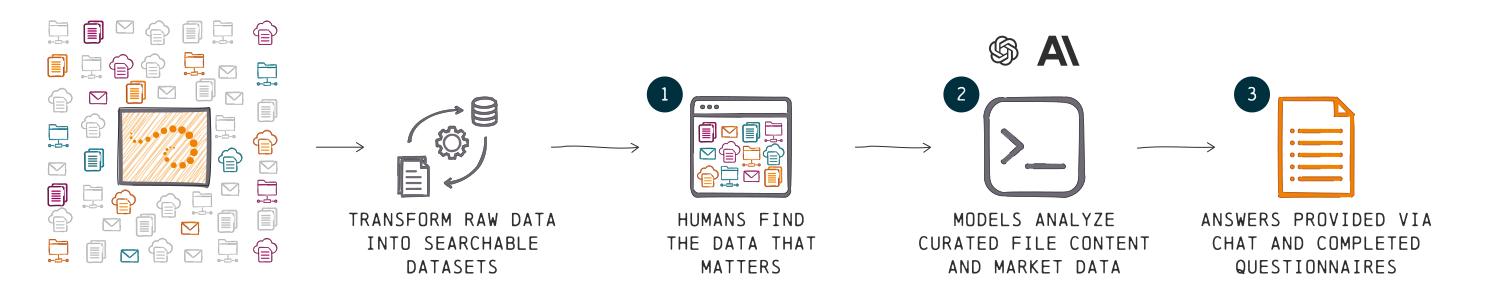
Thermal changes investment, operations, and deals diligence by letting teams find the exact set of documents that matter using keyword and topic search, translation, and sensitive data identification. Thermal's AI then runs only on that curated set, with workflows designed for volumes that exceed single-conversation limits. Every answer is sourced, reviewable, and defensible, making it clear what was considered and why the answer holds up.
How Diligence Changes with Thermal
- From volume → focus
Analysts start with thousands of files and use forensic-grade keyword and topic searches, translation, and sensitive data identification to narrow the set, reviewing highlighted document content directly within Thermal and tagging what moves forward for analysis. - From searching → analysis
With the right documents identified, analysts ask targeted questions, surface discrepancies, and complete diligence questionnaires in a fraction of the time, reviewing curated content alongside external market and performance data to validate conclusions and flag gaps. - From assumptions → defensible answers
Every answer traces back to the source file, paragraph, and page. When a question arises post-close, you have the audit trail: what was searched, what was reviewed, what the model considered, and what it returned.
Use Cases
- Investment and operational diligence for asset managers and portfolio oversight
- Risk assessments (e.g., NIST, CIS)
Classification
After a breach, do you know what content was affected?
Or only that files were encrypted or copied?
IDENTIFY SENSITIVE DATA
Breach response is the work of understanding exposure quickly enough for accurate notifications to go out on time.
While breach response is triggered by specific events, it is recurring work for the teams and consultants responsible for responding.
After a breach or ransomware event, digital forensics teams will provide the compromised files. The unanswered question is what's inside them. Is it an HR export with employee details, or a public product launch deck. Breach response teams need to quickly understand the content of compromised files so they can determine exposure accurately and avoid sending one notice, then another, then another as new facts emerge.
Real World Use Case
In a large-scale breach response, teams needed to analyze 440 million documents and emails under regulatory deadlines. The effort required 500 consultants, 20 tools, and three cloud platforms, extended a 60-day notification window to 12 months, and cost $60M. Thermal is designed to materially simplify breach response programs of this scale, enabling service providers to handle more matters with smaller teams and helping organizations meet regulatory reporting obligations faster and at significantly lower cost.
What Thermal Solves
In a breach response, speed and accuracy matter. Consultants are handed hundreds of gigabytes to terabytes of files and then create a way to understand which files contain sensitive personal, health, and financial information quickly enough to meet reporting deadlines, without overstating or understating exposure.
Standing up new infrastructure, stitching tools together, or manually sampling files wastes time teams don't have. Meanwhile, notification clocks continue to run.
Thermal fixes that.
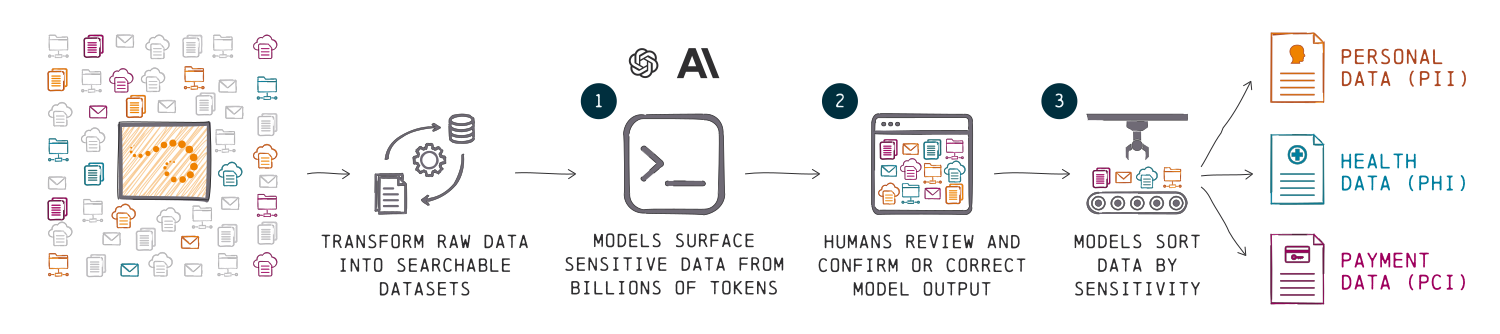
Thermal changes ransomware and data breach response by rapidly surfacing files that contain sensitive information, and organizing files across the impacted dataset by the type and sensitivity.
When ransomware encrypts systems, Thermal provides immediate visibility into previously indexed content, allowing teams to assess what data was affected even while files remain inaccessible and recovery is still underway.
In a data breach, Thermal enables teams to move immediately from triage to analysis, applying the appropriate combination of machine learning, AI, and deterministic pattern matching to identify files containing PII, PHI, and PCI, without standing up custom processing pipelines under deadline pressure.
How Breach Response Changes with Thermal
- From infrastructure → analysis
Breach response often involves massive volumes of unstructured data that exceed what traditional tools and off-the-shelf AI can handle. Thermal ingests the impacted dataset directly, performs rapid triage, and applies the appropriate analytic method per file so teams can begin review immediately. - From uncertainty → visibility
Security teams and incident response consultants move from knowing files were affected to understanding what data those files actually contained. Keyword and topic search, combined with targeted analytics, allow sensitive content to be identified quickly and defensibly. - From waiting → deciding
Thermal enables teams to assess exposure, determine reporting scope, and support notification decisions while response and recovery efforts are still in progress, not weeks later.
Use Cases
- Ransomware readiness and impact assessment
- Data breach response and regulatory reporting
Remediation
Patient data extends far beyond the electronic health record.
Can every copy be found, preserved in the EHR, or deleted?
Clean Up Distributed Medical Data
Patient data rarely lives in just one place.
Clinical notes are drafted and revised on laptops. Diagnostic images are reviewed on shared workstations. Transcriptions are exchanged with third parties. Emails are sent to patients. Files are copied, forwarded, and stored wherever work happens fastest.
While the electronic health record remains the system of record, regulated medical data accumulates across endpoints, file shares, and collaboration tools over time.
When organizations attempt to address this sprawl, they face two hard problems at once: finding every instance of regulated data, and deciding what must be preserved in the EHR versus what must be removed. Without a consistent process, cleanup efforts become manual, disruptive, and difficult to defend later.
Real World Use Case
In a multi-location outpatient healthcare system, clinicians met with patients virtually and in person, using shared workstations and laptops carried between exam rooms. Clinical notes, diagnostic images, and patient communications accumulated across devices, email, and file shares outside the electronic health record. The organization had no reliable way to identify every instance of regulated patient data, determine what needed to be preserved in the EHR, or confirm that out-of-place copies were deleted. Thermal is designed to help healthcare teams locate, review, preserve, and remediate distributed medical data at scale.
What Thermal Solves
Medical data remediation requires turning policy and clinical intent into consistent action across every identified copy of regulated data. For program leaders, the challenge is coordinating scope and execution across millions of files and hundreds of people, and being able to show what happened.
Without a single system of record, employee guidance is distributed by email, remediation progress is tracked in spreadsheets, and keep, separate, or delete remediation action decisions drift as the same file is handled differently in different places. Leaders lose visibility into whether work is stalled, complete, or inconsistent.
Building user guidance dashboards, integrating with support ticketing platforms, and transforming data for visual leadership reporting can take weeks to months.
Thermal fixes that.
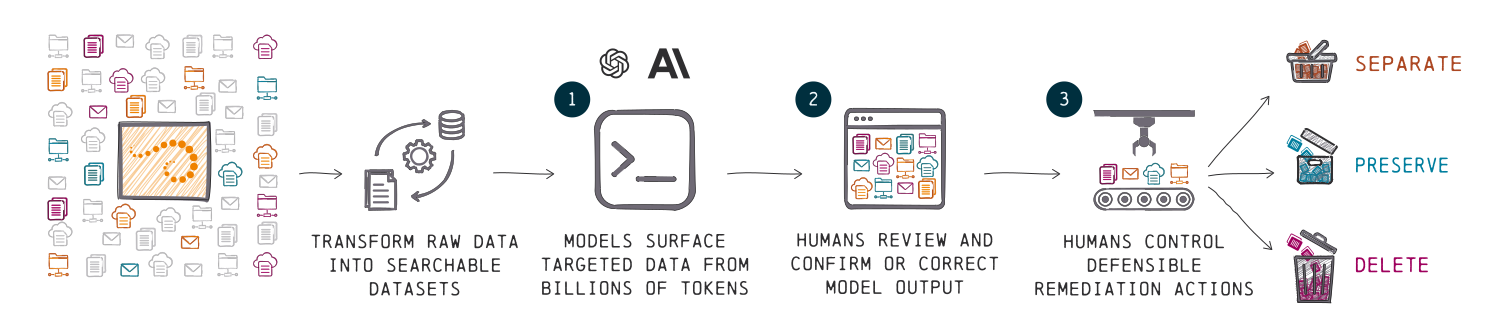
Thermal changes remediation by connecting search, review, and action in one workflow. Centrally defined criteria surface the right files, users review and apply clear remediation tags. Data separation, preservation, and permanent deletion to Department of Defense (DoD) standards actions are executed reliably across every copy, with an immutable audit trail showing what was found, what was done, and why.
Thermal's workflows connect people to the work. Employees review guidance in a dashboard that moves along with them, ask questions using Thermal's integrating ticketing, and stakeholders get real-time visibility to progress and consistency as execution moves forward.
How Data Remediation Changes with Thermal
- From volume → focus
Thermal uses AI to make sense of massive, distributed data volumes, reducing hundreds of millions of files into a focused set that reflects centrally defined criteria. Human review starts with what actually matters. - From focus → judgment
Employees or central review teams review responsive files using keyword and topic search, confirming or correcting suggested remediation actions as they go. Human judgment stays in control at every step. - From judgment → action
Once decisions are confirmed, Thermal executes remediation actions directly on source data: keep in place, move to buyer or seller, securely preserve, or permanently delete to Department of Defense standards. Every action is recorded in an immutable audit trail. When the question arises, you can show what happened to any specific file.
Use Cases
- HIPAA and EHR medical data remediation
- Antitrust and competition compliance reviews