Markets
Thermal Delivers the Last Mile From Discovery to Action
Thermal supports teams operating across FinTech, RegTech, and LegalTech markets, where work is governed by strict rules and tight timelines. This work is rarely discretionary. It exists because it has to.
Diligence, regulatory compliance, breach response, and legal use cases span these markets. Teams face different mandates but the same underlying challenge: working through massive volumes of unstructured data under time pressure and scrutiny, where mistakes are reportable.
This work requires more than search results or AI-generated answers. Teams need a reliable way to decide what matters, keep humans in control of how AI is applied, and carry decisions through to defensible action.
Ever try finding a virtual data room document by keyword?
And if you do find it, great. Now what?
Built for Real Diligence, Not Superficial Review
Diligence teams should not spend their time opening file after file and running repeated CTRL-F searches.
Great diligence is about finding what matters and being able to explain why.
Thermal helps teams move past manual searching and focus their attention on the content that informs risk, decisions, and defensible outcomes.
Real World Results
Diligence teams using Thermal have indexed over 649,000 files and generated more than 100 million tokens of content for AI language models. By reviewing highlighted search results directly in Thermal's preview pane, tagging what matters, and having documents prepared automatically for AI analysis, teams avoid manual document opening and repeated CTRL-F workflows, reporting hours saved per day along with improved consistency and defensibility.
What Thermal Solves
Web-based AI language models like ChatGPT are easy to use and work well for conversations, but they have real limitations. When documents are introduced, those limitations become apparent in ways most teams don't see.
Diligence teams spend too much time searching for and manually reviewing files and want AI that accelerates their work. For the large documents and data sets they are expected to evaluate, however, these models may not consider everything provided, and some content can be silently ignored without visibility into what was left out.
Thermal changes that.
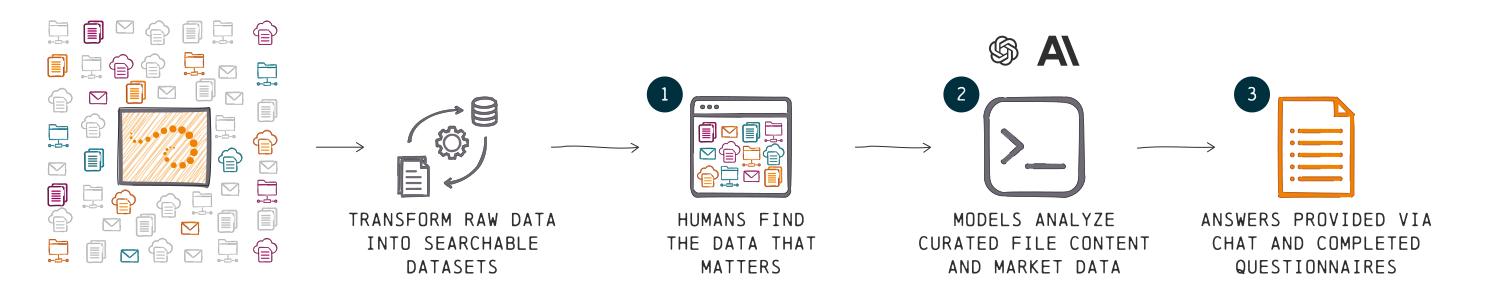
Thermal's enterprise search engine first helps analysts move from thousands of files to a focused set of documents. That curated content is then processed through integrated models using a workflow designed to handle large data volumes, allowing the full set of submitted content to be considered. Every answer is sourced back to the underlying files, enabling more comprehensive diligence delivered faster, with confidence teams can stand behind.
How Diligence Changes with Thermal
- From volume → focus
Analysts start with thousands of files and use forensic-grade keyword and topic searches, translation, and sensitive data identification to narrow the set, reviewing highlighted document content directly within Thermal and tagging what moves forward for analysis. - From searching → analysis
With the right documents identified, analysts ask targeted questions, surface discrepancies, and complete diligence questionnaires in a fraction of the time, using curated content augmented with market data. - From assumptions → defensible answers
Thermal enables human-guided, AI-assisted review at enterprise scale, keeping judgment with the analyst. Every answer is tied back to specific source files, preserving context and auditability.
Use Cases
- Investment, operational, and deals due diligence
- Risk assessments (e.g., NIST, CIS)
Ever try finding a document by keyword on a laptop?
Now find every copy of that file across an enterprise…and delete it.
Built for Regulatory Action, Not Document Hunting
Regulatory programs are defined by coordinating action across thousands of people, millions of files, and immovable deadlines.
Central teams define guidance and track progress, employees take action on thousands of files, and executives need confidence the program will conclude on time, defensibly.
Real World Use Case
In a $2B divestiture, 5,000 employees were required to review 395 million files to determine which data remained with the seller and which transferred to a private equity buyer. The data separation effort relied on six tools, stretched a 60-day regulatory timeline to 10 months, and cost $2M. Thermal is designed to simplify data separations of this scale by consolidating discovery, review, and remediation into a single platform, allowing programs to conclude faster, with fewer people, at lower cost, and with higher margins for service providers.
What Thermal Solves
Regulatory compliance requires more than search. It requires turning centrally defined intent into consistent, defensible action across every instance of in-scope data.
Too often, that coordination breaks down. Guidance is distributed through email. Progress is tracked in spreadsheets. Files are found in one tool, then copied or moved to others as no single system can carry work through to completion. Employees struggle to understand what needs to be done and work through large volumes of files alongside their day jobs. Program leaders lose real-time visibility into whether the work is on track or has even begun.
Thermal changes that.
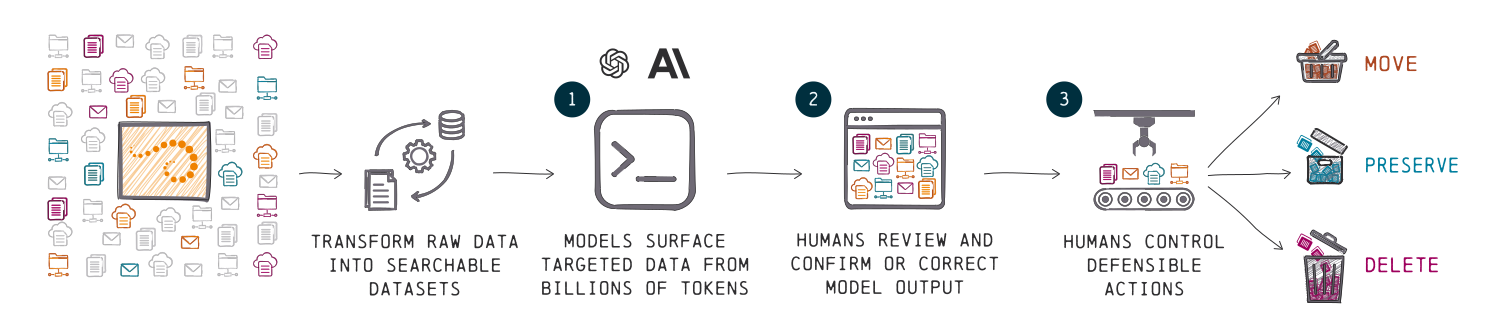
Thermal gives regulatory teams a single system to define search criteria centrally, surface responsive files across the enterprise, and apply remediation actions consistently. Whether review is performed by employees or a central team, each file is reviewed in context, tagged with the appropriate action, and handled in place. Actions are executed reliably across every copy of a file, with an immutable audit trail showing what was found, what was done, and why.
How Regulatory Compliance Changes with Thermal
- From volume → focus
Thermal uses AI to make sense of massive, distributed data volumes, reducing hundreds of millions of files into a focused set that reflects centrally defined criteria. Human review starts with what actually matters. - From focus → judgment
Employees or central review teams review responsive files using keyword and topic search, confirming or correcting suggested remediation actions as they go. Human judgment stays in control at every step. - From judgment → action
Once decisions are confirmed, remediation actions to keep, move, securely preserve, or permanently delete files to Department of Defense standards are executed directly on the source data. Every action is recorded automatically in a complete, immutable audit trail regulators and auditors can rely on.
Use Cases
- Post-deal data separation during TSA periods
- CFIUS & ITAR data risk mitigation via deletion
- HIPAA and EHR remediation of medical data
- Antitrust and competition compliance reviews
After a breach, do you know what content was affected?
Or only that files were encrypted or copied?
Built for Breach Impact Analysis, Not Guesswork
Cyber incidents do not happen on a clean timeline. Teams are under immediate pressure to understand what was affected, what data may be exposed, and what decisions need to be made next.
Many tools are built for recovery after the fact or analysis once systems are restored. In a real incident, teams need answers long before backups are complete, systems are fully recovered, or external reviews can begin.
Real World Use Case
In a large-scale breach response, teams needed to analyze 440 million documents and emails under regulatory deadlines. The effort required 500 consultants, 20 tools, and three cloud platforms, extended a 60-day notification window to 12 months, and cost $60M. Thermal is designed to materially simplify breach response programs of this scale, enabling service providers to handle more matters with smaller teams and helping organizations meet regulatory reporting obligations faster and at significantly lower cost.
What Thermal Solves
After a breach or ransomware event, teams often know that files were encrypted, accessed, or copied, but lack immediate visibility into what content was actually impacted.
Restoring from backup can take days or weeks, and even successful recovery does not explain what content was involved or what must be reported. Critical response decisions are often required long before that visibility is restored.
Thermal changes that.
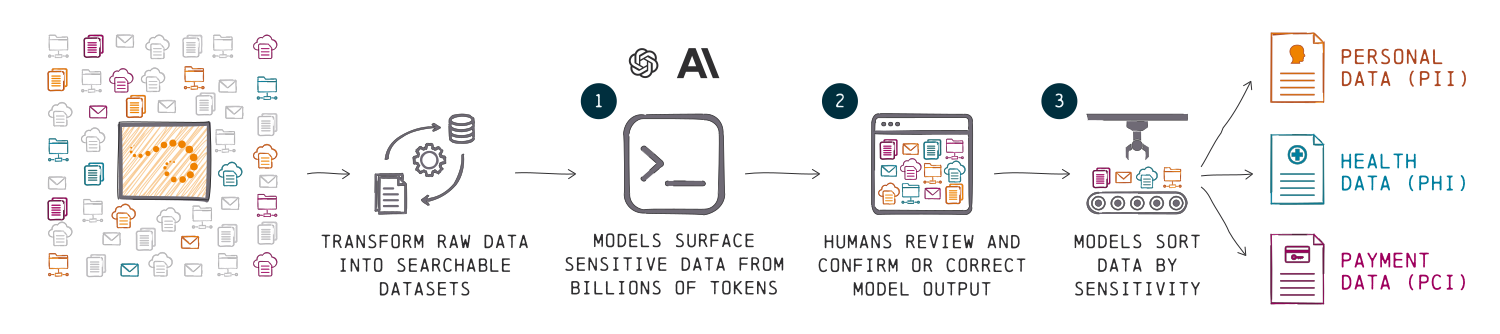
Thermal provides immediate visibility into impacted content, restoring control at the moment teams need it most so they can assess exposure, prioritize next steps, and make informed decisions while response and recovery efforts are still underway. In a data breach, Thermal allows teams to begin review and reporting immediately, without first building infrastructure or assembling processing pipelines.
How Breach Response Changes with Thermal
- From infrastructure → analysis
Breach response often involves massive volumes of unstructured data that exceed what traditional tools and off-the-shelf AI can process effectively. Thermal uses workflows designed to handle that scale, and applies the appropriate analytic method per file, allowing teams to review results immediately instead of first standing up infrastructure under pressure. - From recovery → visibility
Teams move from knowing files were encrypted to understanding what data those files contained. Keyword and topic search allow teams to quickly identify impacted content, even when systems are unavailable. - From waiting → deciding
Backup and recovery are essential for restoring systems, but they do not provide timely visibility into impacted content. Thermal enables teams to assess exposure and determine reporting scope immediately, without waiting for systems to be restored.
Use Cases
- Ransomware readiness and impact assessment
- Data breach response and regulatory reporting
Ever try finding a document by keyword in SharePoint?
And if you do find it, great. Have you found all the related documents too?
Built for Real Legal Work, Not AI Experiments
Legal teams are under constant pressure to find what matters in massive volumes of documents, often under court-ordered deadlines.
This work demands precision, defensibility, and clear control over how results are reached.
Real World Results
After months of stalled progress reviewing 1TB of discovery data, a law firm deployed Thermal and narrowed the dataset to 160,000 potentially responsive files. Within that set, the team conducted targeted searches to identify and tag the documents that mattered for trial, organizing them by witness and charge in days.
What Thermal Solves
In discovery, investigations, and internal reviews, legal teams are often handed enormous volumes of documents and expected to quickly identify relevant material, organize it by matter or witness, and prepare it for review.
Too often, that work devolves into opening file after file, running repeated CTRL-F searches, and manually stitching together relevance across disconnected documents. Finding a file is only the first step. Understanding why it matters, reviewing it in context, and organizing it for the case is where time is lost and confidence starts to slip.
Thermal changes that.
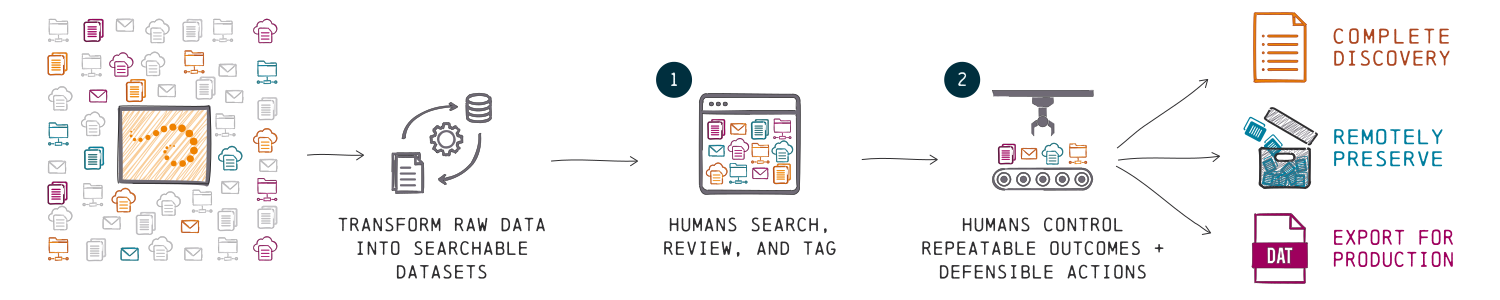
Thermal gives legal teams a forensic-style search experience, similar to LexisNexis or Westlaw, applied to their own data. Teams enter a search once, then review matching language within Thermal, with relevant terms highlighted, clicking through results without opening files one by one. Original files remain unchanged, while comments can be added for team discussion and files can be tagged and organized by matter, custodian, or witness before anything is sent to downstream eDiscovery platforms.
How Legal Work Changes with Thermal
- From searching → review
Teams move from repeated keyword searches and manual file opening to forensic-grade keyword and topic search, with matching content highlighted directly in Thermal. Searches can be scoped to specific parts of a document, producing repeatable results that can be explained and relied on. Responsive documents are reviewed with a click, and tags are applied by matter or witness without opening files one by one. - From fragmented workflows → end-to-end execution
Thermal supports the full discovery lifecycle, from early case assessment through discovery, collection, and production of natives or load files for eDiscovery platforms like Relativity and Nuix. The platform's remote legal hold collection architecture was designed and implemented during COVID, when backlogs of thousands of laptops accumulated with no viable way to preserve data remotely. Tens to hundreds of collections can be completed concurrently, even across distributed custodians and unreliable networks.
When teams choose to use AI, it operates only on human-curated files, allowing attorneys to ask targeted questions of specific documents, with every response sourced and highlighted for review.
Use Cases
- Early case assessment (ECA)
- Litigation and investigation discovery
- Remote legal hold preservation